Clinic Software
Summary: Diagnostic medical software should be chosen based on the specific clinical decision it supports, such as cardiorespiratory testing, lab operations, imaging quality, enterprise records, autonomous screening, or clinician decision support. The best software fits the diagnostic work your clinic handles, ensuring it supports the necessary tests, documentation, and workflows without unnecessary features.
A patient file lands in the queue with an abnormal result, and staff still cannot tell which clinical step comes next. The treating doctor wants confirmation before changing therapy, the diagnostic technologist needs proof that calibration held during data collection, and the front desk has to answer worried families who are waiting for a care plan. Buying diagnostic medical software as a broad IT upgrade usually creates a traffic jam, because the software has to fit the exact diagnostic work your practice does. Picking the right system starts with the medical job your staff repeats every day. That may mean pulmonary diagnostics, laboratory specimen handling, medical image verification, enterprise medical records, autonomous artificial intelligence screening, or guided differential analysis.
Healthcare administrators and medical directors need to separate how patients find a facility from how clinicians carry out testing before they schedule product demonstrations. Searching Clinic Directory profiles lets patients and families compare medical offices across specific cities and states by specialty, accepted insurance networks, offered clinical services, spoken languages, and conveniences like telehealth or online scheduling, while clinical systems handle the diagnostic work behind the counter.
1. MGC Diagnostics: cardiorespiratory disease testing
MGC Diagnostics systems centers on non-invasive diagnostic equipment and software built to detect, sort, and track cardiorespiratory illness. Practices that run spirometry, lung volume assessments, diffusing capacity measurements, or cardiopulmonary exercise testing get the best fit by starting here, since the platform is aimed at respiratory physiology rather than enterprise record-keeping. Pulmonology departments and cardiopulmonary centers find a direct match when patient visits focus on airway resistance, exercise limitation, or respiratory symptoms.
That narrow focus has practical value. Pulmonary specialists can check whether the interface tracks the standard protocols, measurement variables, and clinical grading scales they use in routine clinic sessions.
The limit is functional breadth. A facility that needs specimen tracking for a clinical lab, hospital-wide chart distribution, or fully autonomous machine-learning reads has to run separate secondary platforms. For an outpatient lung center or a dedicated cardiology suite, a targeted program avoids paying for enterprise modules nobody needs, while still giving cardiopulmonary operators tools built for their testing equipment.
2. Clinisys: clinical laboratory systems
Clinisys laboratory software works as an enterprise platform for laboratory operations, with the vendor presenting itself as the leading international clinical laboratory systems developer. Laboratory managers sorting through digital options should put Clinisys near the top when the operational problem centers on accessioning samples, tracking bench work, and sending pathology data, rather than giving doctors a bedside differential assistant. High-throughput diagnostic facilities depend on this setup when lab testing is the main diagnostic engine of the business.
Clinical buyers look closely at how test orders move across instruments, how technologists validate critical values, and how analytical results route into wider medical facilities. Because this platform is full laboratory infrastructure rather than a light accessory, administrators need to check that its capacity matches their regulatory duties and daily specimen numbers.
Putting in an enterprise laboratory information platform can create extra administrative work for low-volume facilities. An outpatient group running only point-of-care capillary blood tests or basic urinalysis strips should review specimen volume before looking at a large vendor, since heavy software overhead pays off only when testing complexity calls for structured laboratory protocols.
3. MEDITECH: healthcare organization information systems
MEDITECH healthcare systems come from Medical Information Technology, Inc., a Massachusetts software provider that builds electronic health records for health systems and hospitals. MEDITECH belongs on an evaluation shortlist whenever diagnostic results need to connect directly to enterprise health records, order entry systems, and hospital billing instead of sitting inside isolated diagnostic applications. Hospitals and regional health networks use this platform to bring diagnostic reporting together with broader inpatient or outpatient charts.
The operational question reaches beyond recording test outcomes. Leadership has to judge whether cross-department communication, clinician order sets, and patient histories work together across nursing floors and outpatient centers.
The trade-off is departmental specialization. An enterprise health record rarely gives the fine-grained controls needed by an exercise physiology lab, an imaging quality assurance team, or a specialty screening service. Healthcare groups often place MEDITECH at the center of operations, then connect specialized diagnostic programs to its database for departmental data capture.
4. Digital Diagnostics: autonomous AI diagnosis
The Digital Diagnostics platform is notable as the first developer to receive FDA clearance for an autonomous artificial intelligence diagnostic tool, one that issues a clinical decision without physician oversight. Clinics that review automated diagnostic products need to treat that clearance as its own operational class, because hands-off decisions call for accountability rules that assistive tools do not require.
Primary care networks and specialized screening centers use this technology when they want standardized, protocol-driven diagnostic evaluations rather than open-ended diagnostic suggestions. It works best in an environment where certified clinic staff can run intake imaging hardware, record screening findings correctly, and move patients through confirmed care paths without treating the software like a casual consult engine.
Autonomous artificial intelligence brings strict clinical governance with it. Administrative leaders have to name who handles device calibration, technician competency training, result documentation, and fast patient handoffs whenever the automated analysis finds disease. A clinic should check its internal process for positive findings before buying it, because an autonomous diagnosis brings no clinical benefit if office workflow cannot send the patient to urgent treatment.
5. Diagnomatic: imaging quality proof for audits
Diagnomatic analysis software pairs physical test phantoms with automated evaluation software, so medical physicists can show that radiology hardware meets strict performance criteria through verifiable data that stands up in an audit. Imaging centers should choose Diagnomatic when the weak point is not radiologist image interpretation, but the inability to prove imaging machine calibration during regulatory inspection.
Medical physicists use this software. Outpatient radiology facilities use it too, along with hospital imaging suites, to meet quality assurance mandates. The main advantage is documentation that can be checked, giving quality directors structured records for state inspectors, accreditation bodies, and internal medical audits that ask whether computed tomography or radiography machines met diagnostic image standards.
This tool deals with equipment verification, not clinical image interpretation and not patient scheduling. A radiology group using Diagnomatic still depends on separate picture archiving and communication systems, radiologist reading stations, and intake management software. The platform fits places where proving physical equipment reliability is an explicit compliance requirement, rather than sites looking for patient communication tools.
6. DxGPT: free diagnostic decision support
DxGPT decision support is a no-cost artificial intelligence system for diagnostic reasoning from Foundation29. Medical staff use DxGPT to think through difficult differential possibilities without paying for software subscriptions, especially when they are looking at unusual case presentations instead of filing regulated medical reports. The platform gives clinicians decision guidance that is easy to reach, and it does so without asking for integration into hospital billing or local testing machinery. It suits an individual doctor or a clinical study team that wants to organize broad differential diagnoses while keeping full personal liability and decision-making authority over the final treatment plan.
A medical center that needs billable, regulated diagnostic determinations cannot use DxGPT as a replacement for certified diagnostic medical software, since its intended role stays limited to cognitive support for clinicians. The working setup keeps the tool in exploratory diagnostic brainstorming, while documentation, laboratory confirmation, and billing entry stay with standard clinic software systems.
How to choose diagnostic software without buying the wrong category
Choose diagnostic software by naming the one clinical decision it must support, then compare only vendors in that category.
Clinical leaders need the exact medical judgment in view before they pick a software package. Comparing MGC Diagnostics, Clinisys, MEDITECH, Digital Diagnostics, Diagnomatic, and DxGPT means sorting six separate technical groups: physiological measurement, laboratory sample coordination, enterprise record management, autonomous diagnostic screening, imaging hardware quality verification, and clinician case brainstorming.
Before vendor meetings are booked, staff should write the core clinical question in one sentence. The software must classify respiratory function, process specimen runs, log full patient charts, confirm imaging safety, screen on its own, or suggest differential pathways. That boundary keeps common buying mistakes out of the process. It keeps teams from signing for an AI demo when the lab needs specimen tracking, or from buying a huge electronic health record when the physics team lacks audit logs for equipment quality.
Recent regulatory decisions show how specialized diagnostic programs have become. Longevity.Technology reported in October 2026 that the FDA granted 510(k) clearance to NeuroXT for its NEXT-Cue Alzheimer's risk software, an artificial intelligence tool that reads brain MRI scans for people with mild cognitive impairment.
Axis Imaging News reported in October 2026 that Deep Reasoning AI secured FDA 510(k) clearance for NeuroDR artery visualization, which turns head and neck computed tomography angiograms into three-dimensional vascular reconstructions. These approvals point to software built for a narrow anatomical or disease-specific task, not for general medical problem-solving.
Specialty imaging keeps getting regulatory validation across diagnostic fields. Diagnostic Imaging also reported in October 2026 that FFR-IQ achieved 92.2 percent sensitivity while calculating non-invasive fractional flow reserve from coronary computed tomography angiographies. Clinicians comparing cardiology, neurology, or radiology software should read these developments as proof that adoption works best around a single diagnostic test, not around broad all-in-one claims.
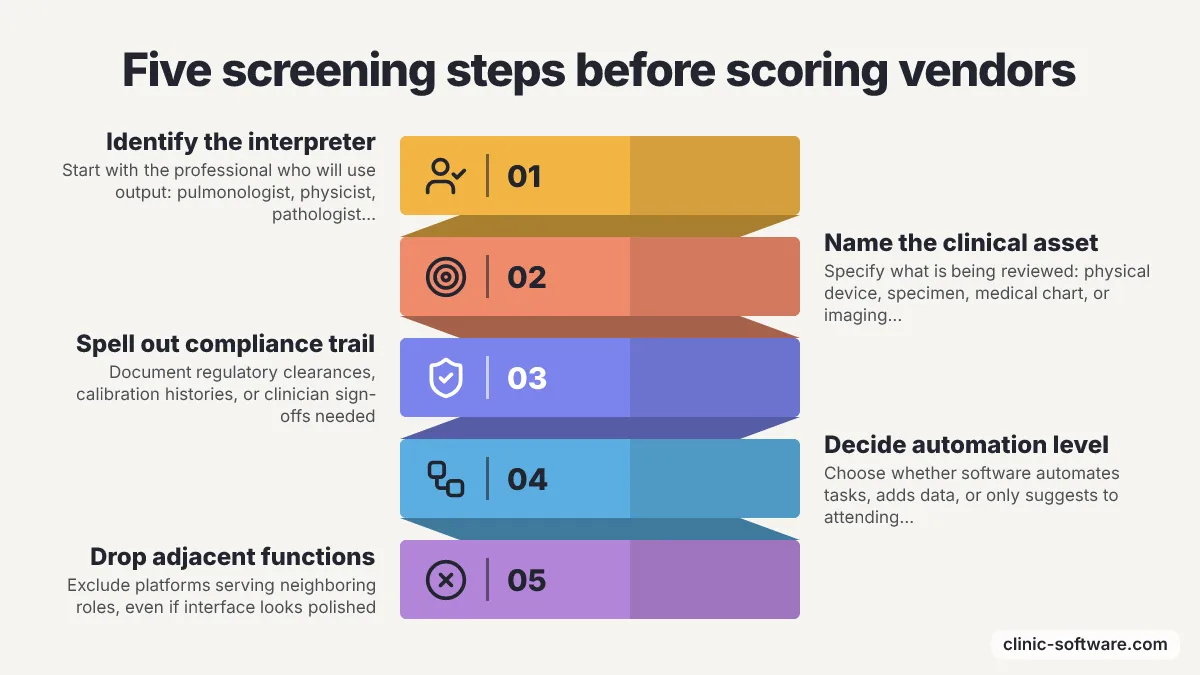
Medical practices should run five screening steps before they score vendors:
- Start with the professional who will interpret the output, such as a pulmonologist, medical physicist, pathologist, or radiologist.
- Name the clinical asset being reviewed, whether that is a physical testing device, laboratory specimen, medical chart, or imaging phantom.
- Spell out the compliance trail that is needed, including regulatory clearances, machine calibration histories, or clinician sign-offs.
- Decide whether the software automates a procedural task, gives extra data, or only offers suggestions for an attending physician.
- Drop platforms that serve a neighboring clinical function, even when the interface looks polished.
Clinic Software gives an active directory of medical practice and clinic software platforms, built by Clinsight. Buyers can use the directory to sort vendors by geographic location and clinical focus, then compare fee structures, target user bases, and stated functionality before they treat different software categories as if they were the same thing.
In our directory, 697 Diagnostic Imaging clinics are listed across 234 cities as of November 2026, which shows that diagnostic software needs vary a lot across practice models. An independent radiology suite, a hospital pathology lab, an outpatient pulmonary clinic, and an urgent care center each work under different conditions, so each needs software shaped for that setting.
Patient discovery tools need to stay separate from clinical diagnostic evaluation. Clinic Directory handles public directory searches rather than medical appointment scheduling, fee collection, or clinical care, and that makes it a useful reference for how patients find practices without overlapping with diagnostic software implementation. When a practice updates its diagnostic service line or buys specialized testing equipment, staff can send out a Clinic Software review request kit to collect patient feedback on scheduling access and staff responsiveness, though patient satisfaction surveys should never replace clinical verification when judging diagnostic software performance.
Conclusion
Draft a workflow protocol on a single sheet of paper before contacting vendors, specifying the exact diagnostic test, the staff member operating the system, the required output format, and the regulatory record your clinic must preserve. A cardiopulmonary team, an imaging quality assurance physicist, and a laboratory director operate under distinct legal and clinical constraints that require separate software categories.
Audit your current diagnostic handoffs to locate where staff experience documentation delays or ambiguous test results. Software cannot correct poorly organized diagnostic pathways, so practice managers must verify technician responsibilities and clinician review steps before scheduling sales demonstrations. Once your practice validates this operational pathway, narrow your vendor demonstrations strictly to the category matching that workflow, leaving pricing discussions, data security audits, and staff training schedules for after you have discarded mismatched platforms.
Frequently Asked Questions
What is the best diagnostic software for cardiorespiratory disease testing?
MGC Diagnostics is a strong fit for cardiorespiratory disease testing. It focuses on non-invasive diagnostic equipment and software designed for respiratory physiology, making it ideal for practices that conduct spirometry, lung volume assessments, and cardiopulmonary exercise testing.
Which software should clinical laboratories consider for managing operations?
Clinisys is recommended for clinical laboratories looking to manage operations. It serves as an enterprise platform for laboratory operations, focusing on accessioning samples, tracking bench work, and sending pathology data, making it suitable for high-throughput diagnostic facilities.
How does MEDITECH support healthcare organizations?
MEDITECH supports healthcare organizations by providing electronic health records that connect diagnostic results directly to enterprise health records, order entry systems, and hospital billing. It is used by hospitals and regional health networks to integrate diagnostic reporting with broader patient charts.
What makes Digital Diagnostics unique in AI diagnosis?
Digital Diagnostics is unique because it was the first to receive FDA clearance for an autonomous AI diagnostic tool that issues clinical decisions without physician oversight. It is used by primary care networks and screening centers for standardized, protocol-driven diagnostic evaluations.
Why would an imaging center choose Diagnomatic software?
Imaging centers choose Diagnomatic software to prove imaging machine calibration during regulatory inspections. It pairs physical test phantoms with automated evaluation software, providing verifiable data that meets quality assurance mandates and stands up in audits.
Is DxGPT free for clinicians to use?
Yes. DxGPT is a no-cost artificial intelligence system for diagnostic reasoning from Foundation29, meant as cognitive support for clinicians rather than a source of billable, regulated diagnostic determinations.
How should a clinic choose between these six platforms?
A clinic should start from the clinical question the software must answer: respiratory testing, specimen processing, enterprise records, autonomous screening, imaging quality proof, or differential brainstorming. Then it should compare only vendors in that category.
Related reading
- Top Clinic Office Software in New York: 3 Picks Compared
- Best Virtual Clinic Software in Pennsylvania: 5 Picks