Clinic Software
Summary: The top virtual clinic software options in Georgia include Azalea Health for EHR-connected visits in Sandy Springs, Corstrata for virtual care delivery in Savannah, QGenda for managing provider capacity in Atlanta, ExamMed for EMR-linked visits in Atlanta, and Global Partnership for Telehealth for clinical endpoints in Blackshear. Each option suits different needs, from integrating with existing systems to managing provider operations and supporting rural healthcare access.
A patient checks in for a remote appointment, but the chart does not load, the clinical notes vanish inside an unintegrated portal, and the front desk burns twenty minutes finding the provider link. Many medical practices learn, after the fact, that a plain video button does not create a workable digital practice. Choosing the top virtual clinics software in Georgia means looking past generic video feeds and dealing with the structural snags in documentation, provider capacity, clinical handoffs, and remote patient access points.
Medical practices across the state work under different operational demands. A rural health clinic that connects remote patients across several counties has different needs than an Atlanta specialty group balancing complex physician schedules, or a Savannah practice running a direct virtual care delivery line.
Regulatory and funding momentum also changes how Georgia providers spend on remote infrastructure. OpenLoop Health reported in September 2026 that Georgia received $93.3 million for rural healthcare through the federal Rural Health Transformation Program, sending federal capital to expand telehealth access, care networks, and clinical facility infrastructure. Picking software now means choosing systems that can live with regional infrastructure shifts, not just temporary calling tools.
Georgia virtual clinic software at a glance
| Option | Location | Best for | What it is |
|---|---|---|---|
| Azalea Health | Sandy Springs | EHR-connected visits | Cloud EHR with built-in telehealth |
| Corstrata | Savannah | Virtual care delivery | Virtual care company and clinical partner |
| QGenda | Atlanta | Provider capacity | Provider workflow, capacity and room assignment |
| ExamMed | Atlanta | EMR-linked visits | Telehealth app that connects to existing EMR and EHR |
| Global Partnership for Telehealth | Blackshear | Clinical endpoints | Nonprofit telehealth network for rural sites |
1. Azalea Health: best for EHR-connected visits in Sandy Springs
The Azalea Health company site describes the Sandy Springs vendor as a cloud-based, interoperable healthcare technology developer. It offers electronic health records with telehealth built in for ambulatory practices, acute hospitals, and health systems. That setup suits organizations that want virtual appointments inside the core clinical record, instead of stranded in separate scheduling software.
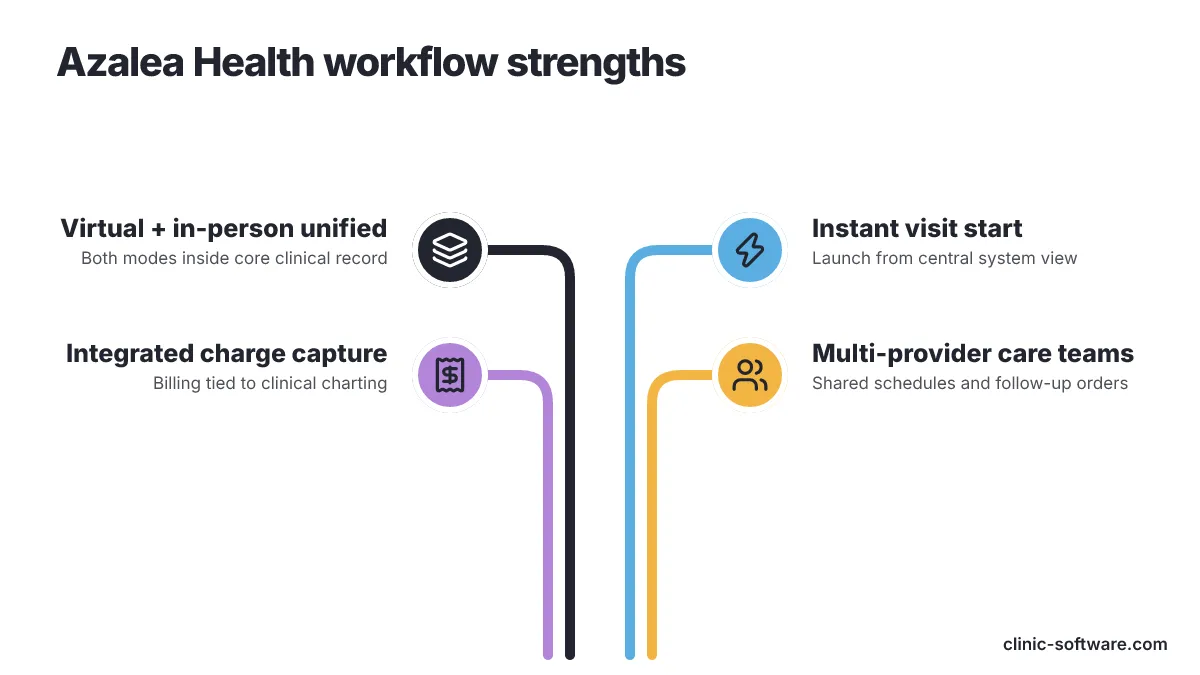
Medical groups with established clinical workflows, revenue cycle requirements, and multi-provider care teams should review an integrated system before they adopt disconnected third-party video tools. That means treating virtual encounters as part of the central operating platform. Software demos should test charting, instant visit start, charge capture, and post-visit administrative tasks, not just video quality.
Healthcare leaders in Georgia who evaluate this platform need to verify how well the workflow handles remote consults and in-person office visits. A system that brings both modes together cuts clerical duplication, as long as clinical staff can follow schedules, finish progress notes, and assign follow-up orders inside one system view.
2. Corstrata: best for virtual care delivery in Savannah
The Corstrata telehealth company site says the Savannah organization works as a virtual care company. It treats patients entirely through digital care models rather than seeing people at its physical office address. That makes the company relevant for healthcare organizations that want a dedicated clinical care delivery partner, not just standalone office scheduling tools. Practices that want virtual-first specialty care programs should look at this care-delivery model early. The material does not present the service as a standard electronic health record replacement, so practice administrators have to confirm how inbound consults, patient chart records, and ongoing treatment documentation exchange data with their existing clinical systems.
The Georgia location gives local practices access to an in-state healthcare provider, yet clinical fit stays the main buying criterion. A local business address does not guarantee alignment with every medical subspecialty. Practice administrators should review how clinical responsibilities are split during the first consult and what routine documentation returns to the primary referring physician.
3. QGenda: best for provider capacity in Atlanta
The QGenda contact page says the Atlanta company serves more than 4,500 healthcare organizations and helps them manage provider workflow, including capacity tracking and room assignment. It fits growing medical groups where telehealth bottlenecks come from clinician availability, staffing gaps, and room limits, not from video quality.
Large multisite systems often roll out remote care tools and then hit a wall. Scheduling templates, room assignments, and physician coverage rules stop matching patient volume. Practice managers turn to capacity software when they need a clear view of which clinicians can take visits, which schedule blocks sit empty, and how physical rooms and virtual rooms get assigned during the day.
Published material does not describe this platform as an EMR or a direct video client, so practice leaders should treat it as a support system. Its main value comes from workforce assignment and room capacity data, not from acting as the main chart or the patient portal.
4. ExamMed: best for EMR-linked visits in Atlanta
The ExamMed company profile says the Atlanta firm, founded in 2015, offers a digital healthcare app that manages telehealth visits and connects directly with existing EMR and EHR databases. That setup suits practices that want remote visits without replacing the record software they already rely on.
Clinics that have spent a lot on their current records system need to look hard at interfaces and sync behavior before they look at the screen design. Test whether visit slots, clinical notes, and later referral orders move cleanly between systems, because medical assistants and physicians will drop extra software that makes them document the same thing twice.
This platform gives a practical path for organizations that want to add virtual visits on top of older infrastructure. Integration tools still need hands-on admin work, so a practice should name an internal project lead to test two-way data sync before it signs the final vendor agreement.
5. Global Partnership for Telehealth: best for clinical endpoints in Blackshear
The Global Partnership telehealth listing says the Blackshear organization is a nonprofit set up to provide telehealth programs that stay affordable while managing a large network of clinical endpoints. That setup fits regional outreach programs that depend on structured clinical sites instead of unattended home video sessions.
Community health programs, rural clinics, and public school systems have to build physical endpoints into their remote software choices. Digital visits fall apart when patients do not have dependable hardware, fast broadband, or staff on site to run diagnostic equipment during the session.
The nonprofit base fits health systems that want low-cost access over time across underserved service areas. When clinical directors compare commercial vendors with this regional network, they should look closely at the hands-on deployment support included, since remote community endpoints bring physical logistics, local partnerships, and staff training along with software administration.
How should a Georgia clinic choose between these options?
Start with the biggest snag in the patient visit, then look only at platforms built to fix that problem. Azalea Health handles record-linked clinical work, Corstrata offers direct virtual care delivery, QGenda handles provider and room allocation, ExamMed supports outside EMR connections, and Global Partnership for Telehealth manages connected endpoint networks for rural sites spread out across a region. Teams that begin procurement by sorting through broad software labels lose time on demos that have nothing to do with their work. The phrase virtual clinic software covers very different products, from embedded EHR messaging features and community access networks to provider capacity tools and full virtual-first clinic operations.
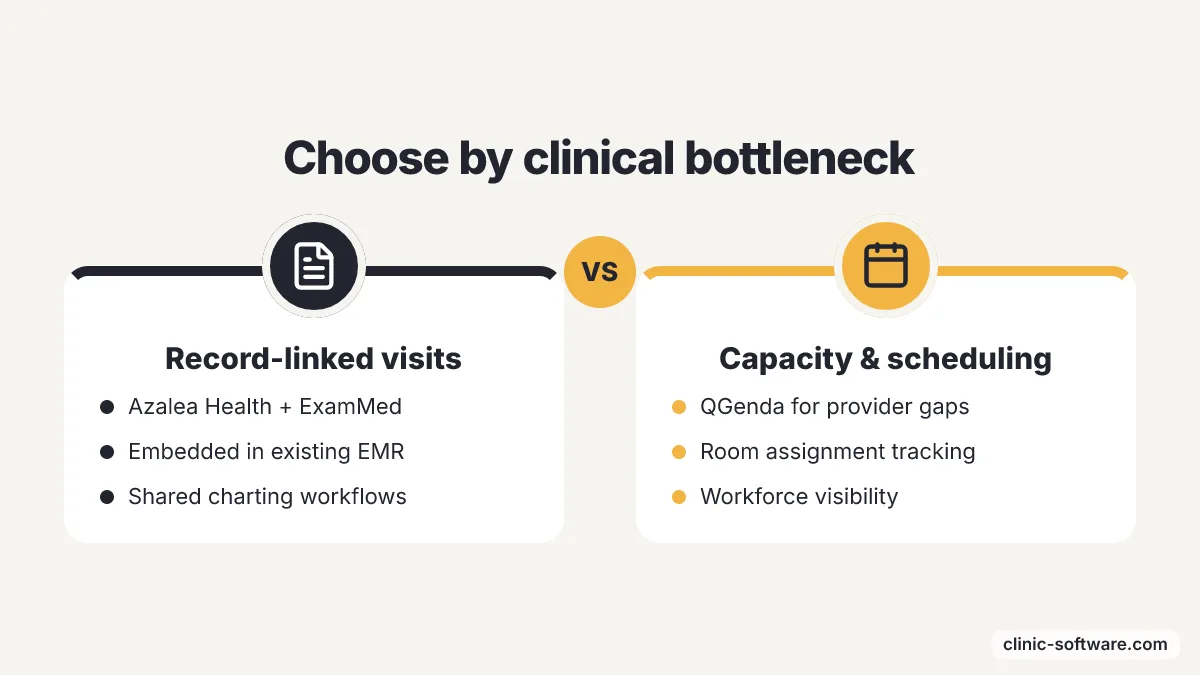
A demo call needs a real clinic scenario, not a vendor script. A family practice should walk through a routine medication reconciliation, from intake to finished documentation. A rural clinic should test an encounter that starts at an off-site partner location, then check that the diagnostic findings return to the main medical chart.
State rules add another layer of screening for local healthcare teams. Policy details published by CCHP show that the Georgia Department of Community Health authorized Medicaid reimbursement for lactation consultations by telehealth starting in April 2026, and the policy required an initial face-to-face visit before virtual follow-up appointments could happen. Clinics serving Medicaid patients need to check whether a platform keeps visit order straight, handles state billing paperwork, and sets up the next virtual appointment for that kind of mixed treatment track.
Federal rules on controlled medication prescribing create a separate workflow test. The joint DEA and HHS update published in December 2025 extended telemedicine prescribing flexibilities through the end of 2026, which allowed licensed practitioners to prescribe controlled pharmaceuticals without a prior in-person clinical assessment. Outpatient mental health providers and chronic disease clinics should examine how patient identity checks, diagnostic histories, and prescription tracking appear in chart views before they launch virtual care pathways.
A solo practitioner doing the occasional check-in, with no need for coordinated scheduling, complex billing links, or rural facility endpoints, should not buy an enterprise platform. The basic telehealth tool already inside an existing practice system costs less and avoids extra software work when visit volume is too low to justify a separate vendor relationship. A healthcare group comparing these Georgia systems while also researching virtual clinic software in Texas needs its own evaluation list, not a copy of this state-based framework. Medicaid reimbursement rules, regional telehealth partner networks, and facility operations vary by jurisdiction, so an in-state software directory works as a method guide rather than a national recommendation.
Clinic Software is a live directory of clinic and practice-management software, built by Clinsight. When evaluating solutions outside this immediate regional group, administrators can review specialized profiles like the 123 Virtual Clinic profile and compare dedicated remote services with internal clinical platforms already handling records and daily operations. Consumer reviews and patient satisfaction ratings need a different test from clinical software testing. The MVP Dental rating profile keeps an average 5/5 score across 270 patient reviews, but virtual care infrastructure selection depends on documentation reliability, interface stability, and the handoffs that happen behind the encounter.
A dependable shortlist should include only applications that finish an end-to-end clinical workflow during a live test. If an engineering team cannot show how a person moves through patient intake, clinical care delivery, charting, and care plan follow-up, the practice does not have the operational evidence needed to buy the tool.
Conclusion: map the care path before vendor demos
Schedule vendor evaluations only after writing down the exact care path the medical team needs to solve. A practice comparing these regional solutions should run the same real-world test scenario in every sales presentation: patient diagnosis, payer billing rules, operational handoffs between medical staff, and electronic health record updates needed for daily operation. Bring the practice manager, a staff clinician, and the medical billing lead into the first workflow review. Set aside one hour to map the exact clinical scenario and note every internal system that visit touches. Product advice stops where clinic procedures begin, because vendor demos cannot solve requirements your clinical team has not clearly mapped.
Frequently Asked Questions
What is the best virtual clinic software for EHR-connected visits in Sandy Springs, Georgia?
Azalea Health is a strong fit for EHR-connected visits in Sandy Springs. It offers a cloud-based, interoperable healthcare technology platform that integrates telehealth directly into electronic health records, which suits organizations that want virtual appointments as part of their core clinical record.
Which virtual clinic software is best for virtual care delivery in Savannah, Georgia?
Corstrata is a good fit for virtual care delivery in Savannah. It operates as a virtual care company, providing digital care models without physical office visits, making it suitable for healthcare organizations seeking a dedicated clinical care delivery partner.
What software should Atlanta clinics use to manage provider capacity?
QGenda is recommended for managing provider capacity in Atlanta. It helps healthcare organizations manage provider workflow, including capacity tracking and room assignment, which suits large multisite systems facing telehealth bottlenecks due to clinician availability and room limits.
Which virtual clinic software integrates with existing EMR systems in Atlanta?
ExamMed is a good fit for integrating with existing EMR systems in Atlanta. It offers a digital healthcare app that manages telehealth visits and connects directly with EMR and EHR databases, allowing practices to add virtual visits without replacing their current record software.
What is the best option for managing clinical endpoints in rural Georgia?
Global Partnership for Telehealth is a good fit for managing clinical endpoints in rural Georgia. It provides affordable telehealth programs with a large network of clinical endpoints, making it suitable for community health programs, rural clinics, and public school systems that require structured clinical sites.
Where to go next
- Blog