Clinic Software
Summary: The top clinic office software options in New York include ClinicTracker, ClinicMind, and Myca. ClinicTracker fits New York-based operations that want integrated EHR and billing systems. ClinicMind suits independent practices seeking a unified system for clinical and patient engagement tasks. Myca, with its New York launch history, is best for practices valuing local experience and operational relevance.
A front desk coordinator in Queens can lose forty minutes just retyping insurance details across three open browser tabs while two exam rooms sit idle, waiting for charts. Practices looking for the top clinic office software in New York run into this mess when software purchases come from product checklists instead of the way a clinic actually moves through the day. State-specific Medicaid billing rules, documentation demands for complex visits, and split-up communication tools can swamp an admin team that has to juggle separate portals.
Choosing office software in New York means putting real workflow ahead of a long menu of features. A direct platform that handles intake, charting, and claims without forcing manual double entry protects cash flow better than a big system full of modules nobody will use. The question is whether the front desk, the clinician, and the billing specialist can finish one visit inside a single path.
Vendor review also has to account for local healthcare requirements in New York, or for a company that already operates in the state. Clinics shopping for medical practice software should not confuse commercial healthcare providers with software vendors, so keep searches for Patients First Dentures & Implants out of office platform demos.
1. ClinicTracker: best for New York-based operations
Based in Fayetteville, near Syracuse, the ClinicTracker EHR billing system puts charting, claims work, and practice management into one system. Groups that want fewer vendor relationships can keep clinical notes and revenue tools under one development team.
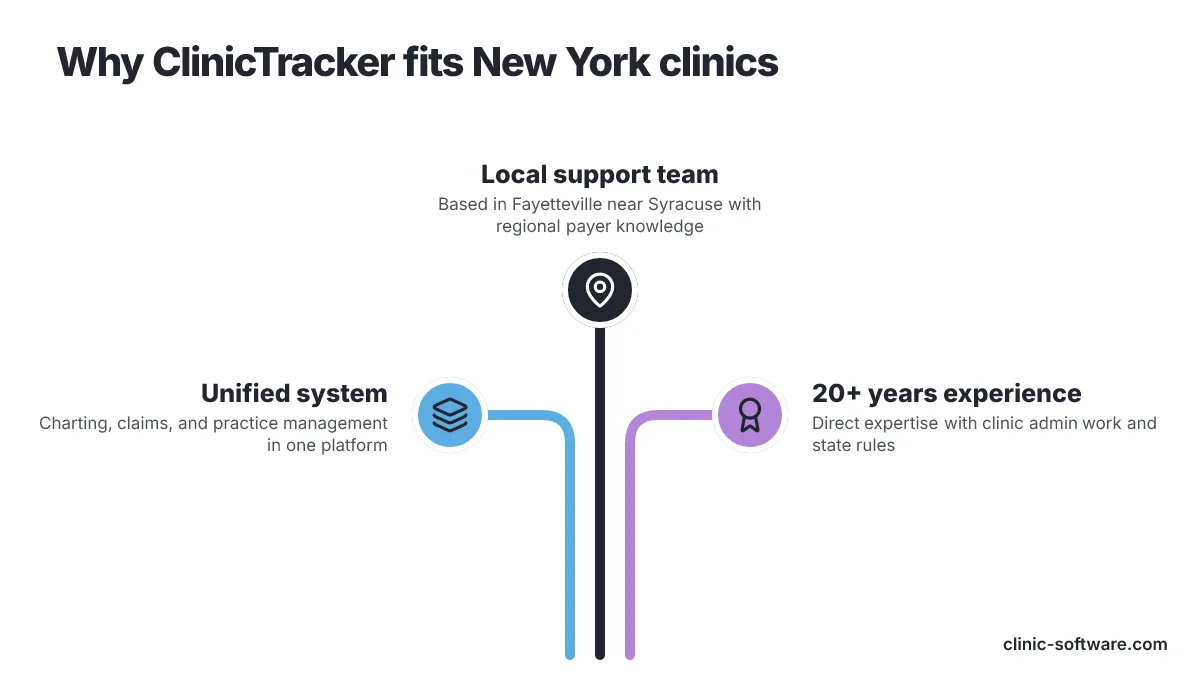
ClinicTracker's support staff in Fayetteville bring local healthcare familiarity, and the company still serves a national user base. Its documentation says the company has worked from Central New York for more than 20 years, which gives its engineering and account teams direct experience with clinic admin work rather than generic office software. Practices dealing with state documentation rules may get quicker help from staff who know regional payer structures. Administrators still need to compare ClinicTracker with their own intake forms and clearinghouse rules before they sign.
A U.S. Headquarters in Onondaga County gives it a useful local presence, but that alone does not mean the out-of-the-box templates or billing rules will fit a specialty clinic without setup.
2. ClinicMind: best for independent practices wanting one system
The ClinicMind independent practice EHR combines electronic charting, scheduling, medical billing services, and automated outreach in one suite, and it aims at physician-owned groups tired of split software subscriptions. Clinic owners who want records and patient messages in the same database avoid the drag of third-party bridge tools. In ClinicMind, front-office work connects automated appointment reminders directly to charting queues instead of sending messages through a separate portal. Buyers should ask for a live demo that follows one patient record from online booking through documentation, claim generation, and post-visit recall messages.
Implementation details need close review before anyone signs onto an all-in-one package. Folding clinical and financial tools into one environment cuts subscription clutter only if permission levels, billing scrubber rules, and task queues match how the staff already divides the work.
3. Myca: best for practices studying a New York launch history
With corporate offices in New York City and international headquarters in Quebec City, the Myca Hello Health background reflects an operating model shaped by direct clinical exposure instead of abstract software theory. Practices that want vendors with old ties to city ambulatory operations will find that history useful in Myca's corporate path. Its development links back to early patient-centered clinic models first built inside New York City. Records show the company launched its first Hello Health clinic in July 2008 in Williamsburg, Brooklyn, giving buyers a clear precedent for judging how patient interaction tools behave in real exam rooms.
Buyers still have to weigh that history against current platform performance. A launch in Kings County and a Manhattan office give it pedigree, but the system still has to prove that patient registration, encounter documentation, claim scrubbing, and communication tools meet modern clinic standards.
How should a New York clinic choose clinic office software?
The safest way to sort office software is to start with the task that eats the most staff time. Practice leaders should ignore the thick feature charts at first and check whether intake, nursing, and billing can move one visit from beginning to end without typing the same thing twice.
Verification of New York Medicaid capabilities should happen before any final software demo score gets locked in. The New York State Department of Health rolled out a centralized portal in August 2026. Medical providers who care for Medicaid recipients must now enroll and revalidate through that single entry point, so clinic leaders need to check how candidate software handles state credentialing data and claim submission rules.
Billing software has to match the work behind complex, long-running care. New York State Medicaid started reimbursement for HCPCS code G2211 coverage on April 1, 2026, and required that Medicaid Managed Care plans follow the policy by June 1, 2026. Vendor demonstrators should show how their charge-capture tools handle the add-on code without creating copayment mismatches for patients.
Artificial intelligence features deserve a live workflow test, not a tour of sales language. In October 2026, eClinicalWorks said platform users would get access to its new AI Workbench deployment starting November 1 to help with prior authorizations, referral tracking, and revenue cycle tasks. That gives buyers a clear yardstick for product reviews, because the vendor has to show how the automation works, not just talk about it.
Clinic Software is a live directory of clinic and practice-management software, built by Clinsight. The directory lets users browse over 1,000 healthcare companies by category and compare details such as features, funding, business model, and target audience. That helps administrators narrow vendor lists before they line up sales demos.
Watching a rep run your own patient scenarios exposes problems that polished scripts hide. A slide deck can look tidy while the actual interface gets in the way.
-
Map one full appointment workflow before the software demo gets scheduled. The sequence has to cover patient registration, insurance verification, clinical chart entry, charge creation, claim filing, and post-visit text follow-up.
-
Ask the vendor to show handoffs between separate clinic roles during the presentation. Practice leaders need to see what happens after the front desk finishes registration, how that chart appears for the clinical provider, and how the billing queue picks up charges without manual work.
-
Test patient communication tools with the messages your clinic actually sends. Dental clinics, for example, can review candidate communication modules beside proven dental office text templates to see whether the software fits their usual outreach schedule and messaging tone.
-
Separate core practice software needs from patient acquisition gaps. A dental organization that lacks chair volume should look at specialized New York DSO marketing agencies before assuming an office management platform will fix appointment shortages.
-
Judge candidate platforms by how much administrative friction they remove, not by how polished the demo looks. A useful scorecard records whether the software cuts duplicate typing, flags payer denials early, and gives staff clear task queues when an appointment ends.
Cash-only specialty practices with steady appointment volume should not put New York Medicaid portal integration or G2211 billing rules at the top of the list when they pick an office management system. A low-cost, light scheduling and notes system can be the practical financial choice for a direct-pay clinic, though staff then have to handle payment reconciliation and follow-up tracking by hand, without automated billing tools.
Growth across several clinic sites changes what software has to do. A solo practitioner often wants a single compact system. A larger healthcare group needs tiered staff access rights, shared financial reporting across facilities, and onboarding steps that do not throw off habits already in place.
Only after a vendor proves the workflow should contract talks and price review begin. Medical practices should look at data migration timing, required staff training, response-time promises for technical support, and hidden software licensing fees after they know the platform can handle the clinic's core operating tasks.
What to do before your vendor demos
Before you talk to a sales rep, pull two real files. One should be a patient visit that went off the rails because communication was messy. The other should be a billing mess that took three revisions to settle. If you are comparing ClinicTracker, ClinicMind, and Myca as the top clinic office software in New York, look at how each one handles regional payer edits, staff to provider handoffs, and plain outgoing text alerts.
Book the demos, then have the vendor open those New York practice records live on screen while your team watches. Let the front desk, the biller, and the providers judge how fast the screens load. See whether names or insurance codes have to be typed again across tabs.
We stop here, right after the demo scoring step. Migration charges, export fees, chart conversion schedules, and ongoing support terms belong in your direct talks with sales reps before anyone signs a contract.
Frequently Asked Questions
What are the best clinic office software options in New York?
The top clinic office software options in New York are ClinicTracker, ClinicMind, and Myca. Each offers unique features tailored to different needs, such as integrated EHR and billing systems, unified clinical and patient engagement tasks, and local operational relevance.
Why is ClinicTracker ideal for New York-based operations?
ClinicTracker suits New York-based operations because it integrates EHR and billing systems into one platform, reducing the need for multiple vendor relationships. Its local support staff in Fayetteville have direct experience with regional healthcare requirements, which can be beneficial for practices dealing with state documentation rules.
What makes ClinicMind suitable for independent practices?
ClinicMind is suitable for independent practices because it combines electronic charting, scheduling, billing services, and automated outreach in one suite. This integration helps physician-owned groups avoid the hassle of managing multiple software subscriptions and ensures that patient records and messages are stored in the same database.
How does Myca's New York launch history benefit practices?
Myca's New York launch history benefits practices by providing a vendor with deep ties to city ambulatory operations. Its development is rooted in patient-centered clinic models first built in New York City, giving buyers an early record of how its patient tools were used in real exam rooms. This history can be useful for practices valuing local experience.
What should clinics consider when choosing office software in New York?
Clinics should prioritize real workflow needs over extensive feature lists when choosing office software. It's important to ensure that the software can handle tasks like intake, charting, and claims efficiently without manual double entry. Verification of New York Medicaid capabilities and the ability to manage complex billing rules are also crucial factors.
Does clinic office software need to handle New York Medicaid billing changes?
Practices that bill New York State Medicaid should confirm that candidate software handles the centralized provider portal enrollment data and the G2211 add-on code for complex care visits without creating copayment mismatches. Cash-only specialty practices with steady appointment volume can put these billing rules lower on the list and focus on scheduling, notes, and follow-up tracking.
Related reading
- 6 New York DSO Marketing Agencies to Compare First
- Effective Dental Office Text Messaging Templates
- Best Virtual Clinic Software in Pennsylvania: 5 Picks
Where to go next
Sources
- ClinicTracker - About Us
- ClinicMind
- Myca (Hello Health)
- eClinicalWorks: Redesigned EHR platform, AI Workbench, healowIQ and new pharmacy/inpatient units unveiled at National Conference
- NY State Department of Health: New Medicaid Provider Services Portal launched statewide
- NY State Medicaid Update: Coverage added for HCPCS code G2211 for complex care visits