Clinic Software
Summary: Multidisciplinary clinic software is essential for ensuring seamless coordination among various healthcare providers involved in a patient's care. The best software options facilitate efficient record-keeping, scheduling, and billing workflows that align with the shared responsibilities across different disciplines. Key considerations include the clinic's specific operational needs, such as multi-location management, inter-department communication, and integrated care settings. In short: Meddbase suits device-agnostic, patient-led services; Clinicmaster fits multi-branch networks; Clinicia handles inter-department communication; Cliniro coordinates shared care pathways; BeebeeDoc manages tight room allocation; and ClinicSense supports therapy-centred wellness clinics.
A physiotherapist wraps up a rehabilitation plan, and then the front desk finds out the patient also needs a massage slot, an updated physician note, and an insurance code that the software will not attach to the same file. The receptionist books the chair anyway. By the time the patient leaves, the chart, the referral letter, and the invoice have already drifted into three separate tools.
Evaluating multidisciplinary clinic software means looking at the handoffs it protects, not the count of features on a sales sheet. The software only works when its clinical charts, appointment books, and billing rules match the way different disciplines divide work for one person. A combined wellness practice needs a setup that looks nothing like what a large multi-location medical group buys. A solo-discipline office rarely needs this much complexity. The six systems below deal with the same basic problem in different ways, letting multiple clinicians coordinate care across one visit without duplicate documentation, missed referrals, or billing disputes.
1. Meddbase: secure patient-led services on any device
Cloud access defines how Meddbase multidisciplinary EHR runs. Multidisciplinary organisations use it for patient-led clinical services in web browsers, with no dedicated local servers and no custom network hardware. Large practices get the most from it when clinical teams need secure remote access on phones, tablets, or home laptops without paying for an internal IT engineering unit to keep the connections alive.
Staff members rarely stay at one desk all day. Meddbase supports teams that move between intake scheduling, specialised clinical charting, and post-visit follow-up, while keeping every note tied to one continuous patient record across departments.
Procurement teams should check this software by following one patient pathway during the demo. User permissions and task assignments need to stay separate for receptionists, treating clinicians, and billing staff. Ask to see a full cross-discipline handoff, not a demonstration that stays inside one clean provider profile.
2. Clinicmaster: multi-location operations under one roof
Multi-facility coordination is the main focus of Clinicmaster clinic operations. The platform pulls calendar management, automated charting tools, billing ledgers, and reporting into a central interface built for multi-location, multi-disciplinary practices. Clinic networks get the clearest benefit here when they run into administrative friction from tracking staff hours, claim statuses, and revenue numbers in disconnected software programs that refuse to sync.
Centralised visibility gives clinic executives an immediate view of overall business health across satellite sites. That matters because a single-room clinic cares mostly about quick front-desk intake, while multi-site practices have to tell whether chart backlogs, open treatment slots, or unpaid claims belong to one struggling branch or point to a network-wide pattern.
Demo calls should test cross-location reporting filters right away. Clinical directors should ask sales representatives to show unbilled appointments, incomplete patient charts, and clinic room usage figures across every operating location, then isolate data for one discipline without exporting rows to an external spreadsheet.
3. Clinicia: inter-department coordination for multi-speciality clinics
Departmental communication drives the structure of Clinicia multi-speciality software. It combines patient booking, electronic medical records, invoicing, direct messaging, and inter-department coordination in one tool. Facilities find it useful when patients regularly move between diagnostic, medical, and therapy wings, because internal communication slips turn into immediate scheduling mistakes that can wreck an afternoon schedule.
Inter-department handoffs are the main problem this platform is built to solve beyond basic scheduling. Built-in routing tools let receptionists and physicians send intake summaries, diagnostic orders, and specialist follow-up requests between units inside the patient chart, leaving secondary chat apps and printed paper notes out of the process.
Evaluation teams should test this system with a multi-step patient scenario. Run a case where a patient books an initial consultation, receives clinical notes in the electronic chart, settles an itemized bill, and generates an automated referral note to a separate internal department. That exercise shows exactly how many screen changes the process requires.
4. Cliniro: integrated health-centre records and referrals
Care-plan coordination sits at the center of Cliniro integrated clinic software, a management platform built for integrated health centers that juggle clinical documentation, incoming referrals, multi-stage treatment pathways, and billing workflows. The strongest fit is for facilities where several allied health professionals work together on long recovery programs. That kind of setup gets the most from a shared record structure.
Collaborative care models need documentation tools that stop each therapy note from drifting off into its own little file. Cliniro ties incoming referrals to long-term treatment milestones, so it suits multi-provider facilities that have outgrown basic shared calendars.
A product demo should show whether referral documents flow into the active patient file or sit around as disconnected inbox tasks. Clinic teams lose real time when therapists have to line up third-party referrals with ongoing care plans and invoices by hand. That is why vendors need to prove the sequence, not just talk about it.
5. BeebeeDoc: specialist and room calendars in the cloud
Resource scheduling forms the foundation of BeebeeDoc cloud management, an online administrative system for multi-specialty practices that balances room allocations, specialist timetables, and administrative oversight under official FSE 2.0 accreditation standards. Practices with tight physical limits, where treatment suites, consulting rooms, and visiting clinician schedules clash, get the most from this spatial setup.
Clinical governance calls for scheduling tools that account for equipment and facility limits alongside physician calendars. In multi-specialty centers, qualified specialists can be blocked from working because an ultrasound suite or therapy room was double-booked. BeebeeDoc avoids that by linking clinical calendars to physical assets.
Accreditation standards call for concrete operational checks, not passive sales claims. Clinic administrators should confirm exactly what FSE 2.0 compliance means for their regional documentation mandates, then ask the vendor to show a complex booking that needs a clinical director sign-off, a designated treatment room, and a visiting specialist timetable.
6. ClinicSense: wellness and therapy clinics that want one system
Practitioners in complementary health settings are the focus of ClinicSense wellness software, an all-in-one administration system built for massage practitioners, physical therapists, and wellness professionals, serving thousands of operational centers. Independent and mid-sized clinics offering physical therapy, bodywork, and restorative care usually find this plain, low-maintenance interface a good fit for daily work.
Therapy practices rarely need the hospital billing modules found in regional medical health networks. ClinicSense centers on online scheduling, client health history forms, automated appointment reminders, and straightforward payment collection. That gives multi-practitioner wellness centers the coordination they need without extra software baggage.
Software buyers should not pay for administrative features they will not use, especially when those features slow down daily charting. A collaborative wellness center needs to confirm that the system handles intake paperwork, charting notes, and invoicing cleanly for each wellness specialty before onboarding.
How should a clinic choose among the six?
Start with the handoff that fails most often in your practice, then judge vendors by how well they fix that one break. In multidisciplinary settings, the usual trouble comes from four places: charts fail to move between specialists, appointment times clash with room availability, referrals disappear from view, or multi-provider billing codes stall at checkout.
| Platform | Best fit | Main handoff it protects |
|---|---|---|
| Meddbase | Patient-led services on any device | One continuous record across departments |
| Clinicmaster | Multi-location clinic networks | Cross-location reporting on charts, slots and claims |
| Clinicia | Multi-speciality clinics | Inter-department messages inside the patient chart |
| Cliniro | Integrated health centres | Referrals tied to treatment milestones |
| BeebeeDoc | Room-constrained multi-specialty practices | Specialist calendars linked to rooms and equipment |
| ClinicSense | Wellness and therapy clinics | Intake, charting and payment in one system |
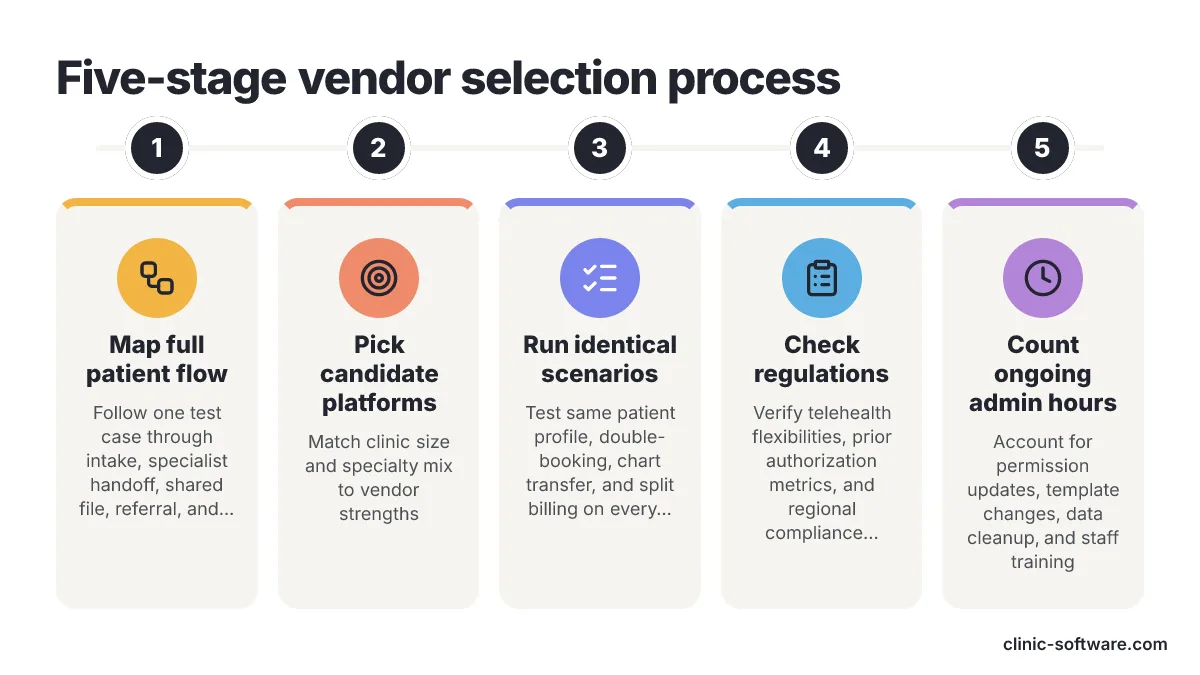
Practices should move through the selection process in these stages:
-
Map the full patient flow across disciplines. Use one test case that follows intake, a move to a second therapist, the shared medical file, the referral step, and the final combined bill. That exposes where generic software starts to fail.
-
Pick candidate platforms that fit your clinic size and specialty mix. Meddbase suits device-agnostic, patient-directed operations. Clinicmaster fits multi-branch clinic networks. Clinicia handles communication between departments. Cliniro coordinates shared care pathways. BeebeeDoc manages tight room allocation. ClinicSense supports therapy-centered wellness clinics.
-
Make every vendor run the same clinical scenario. Use the same patient profile, the same double-booking problem, the same chart transfer, and the same split-billing ledger. That keeps sales reps from hiding weak spots behind polished generic demos.
-
Check regulatory changes and outside reporting rules before you sign anything. Noridian issued a Medicare announcement in February 2026 confirming that the Consolidated Appropriations Act, 2026 extended Medicare telehealth flexibilities through December 31, 2027, while a March 2026 analysis by BlueBrix explained that the first mandatory public prior authorization metrics under rule CMS-0057-F evaluated data from calendar year 2025.
-
Count the ongoing admin hours needed to keep the system configured. Software with regional regulatory compliance, multi-site management, and advanced clinical reporting takes internal time for permission updates, chart template changes, data cleanup, and staff training that never really stops.
A narrow dental office like the Gateway Dentistry listing, which shows a 4.9/5 rating across 220 patient reviews, should stay away from multidisciplinary suites unless the practice actually works with physical therapists, medical specialists, or shared-care programs. Single-discipline clinics burn money and staff time when they buy tools built for care models they do not use. Clinic Software gives an updated directory of practice management and clinical platforms, maintained by Clinsight. Clinic directors can use it to compare categories such as electronic health records, telehealth engines, digital care portals, and administrative practice services, which helps them see whether the bottleneck calls for a software switch or a change in care delivery.
Recent patient complaints can sharpen the demo script before anyone books meetings with sales teams. If patients keep mentioning forgotten referrals, booking errors, or slow replies, collect their exact words with a Clinic Software review request kit and tell vendors to solve those specific problems inside the demo. Virtual visit workflows need separate operational testing if your multidisciplinary team treats people remotely. Practitioners who assess hybrid virtual services can use the Startups 123 virtual clinic resource to plan digital interactions alongside their main clinical management tools.
Shortlists lead to better choices when you keep them to two qualified systems. Pick the two options that match your clinic structure, run the same cross-discipline patient flow on both, and choose the platform that leaves your staff with the fewest manual spreadsheets and paper workarounds.
Next steps: run a scripted cross-discipline demo
Draft a complete, cross-discipline patient flow before you schedule the first demonstration call. Bring an administrative manager, a front-desk receptionist, an active clinician, and a billing specialist into one room for a sixty-minute review, and you get a practical map of where current patient data disappears.
Set up tests only with platforms that match your organization, whether that means a multi-site network, an integrated health center, a multi-specialty department clinic, a room-constrained facility, or a collaborative therapy practice. Cut off talks with any software vendor whose platform cannot pass patient charts, settle room conflicts, track inter-provider referrals, or divide billing codes cleanly during your scripted test. More features will not fix broken administrative coordination.
Frequently Asked Questions
What is the best software for managing multi-location multidisciplinary clinics?
Clinicmaster suits multi-location operations because it centralizes calendar management, charting tools, billing, and reporting into one interface. It provides clinic executives with a clear view of business health across satellite sites, helping to identify whether issues are isolated to one branch or network-wide.
Which software is best for inter-department coordination in multi-specialty clinics?
Clinicia supports inter-department coordination by integrating patient booking, electronic medical records, invoicing, and direct messaging. It is particularly useful in environments where patients move between diagnostic, medical, and therapy departments, ensuring seamless communication and reducing scheduling errors.
How does Cliniro support integrated health centers?
Cliniro is designed for integrated health centers, focusing on care-plan coordination and managing clinical documentation, referrals, treatment pathways, and billing workflows. It is suitable for facilities with collaborative care models where multiple health professionals work together on long-term recovery programs.
What makes BeebeeDoc suitable for multi-specialty practices with limited space?
BeebeeDoc is tailored for multi-specialty practices with tight physical constraints, balancing room allocations and specialist timetables. It links clinical calendars to physical assets, preventing double-booking of treatment suites and ensuring compliance with FSE 2.0 accreditation standards.
Why is ClinicSense a good fit for wellness and therapy clinics?
ClinicSense is designed for wellness and therapy clinics, offering an all-in-one system for massage practitioners and physical therapists. It focuses on online scheduling, client health history forms, appointment reminders, and payment collection, providing coordination without unnecessary complexity.
Related reading
- Top 6 Clinic Accounting Software Options Compared (2026)
- Top Virtual Clinic Software in Georgia: 5 Options Compared