Clinic Software
Summary: The best virtual clinic software in Pennsylvania depends on the specific care model a clinic needs to support. Options include ID Connect for infectious disease telemedicine, AllyHealth for employer virtual care programs, Taction Software for custom clinic platforms, Zivtech for open-source remote monitoring builds, and Penn Medicine OnDemand for urgent virtual care access. Each option addresses different operational needs and reimbursement considerations.
A clinic administrator staring at an open specialty referral queue often hits the same wall quickly. Patients wait eight weeks for an infectious disease consult, while primary care teams try to manage complex follow-up with no dedicated digital tools. Finding the best virtual clinic software in Pennsylvania means looking past generic video platforms, because the best fit depends on the clinic model a practice actually runs. One all-purpose suite rarely handles specialty coverage gaps, remote physiologic monitoring, or employer-sponsored benefit contracts equally well.
State and federal statutory updates have turned software selection into an operations and billing problem, not a software demo. In February 2026, the federal Consolidated Appropriations Act extended Medicare telehealth flexibilities through December 31, 2027, which keeps virtual visit reimbursement in place for outpatient providers. At the state level, the Pennsylvania Department of Human Services introduced remote monitoring procedure codes to the Medical Assistance Program Fee Schedule for services provided on and after August 1, 2026. Medical groups weighing virtual platforms have to match technical features with clinician hours, billing codes, and distinct patient groups.
Pennsylvania virtual clinic options compared
| Option | Based in | Care model | Not a fit for |
|---|---|---|---|
| ID Connect | Pittsburgh | Infectious disease telemedicine and antimicrobial stewardship | Scheduling, patient portal or revenue cycle tools |
| AllyHealth | Philadelphia | Employer-sponsored virtual care programs | Practices that want full control of their own clinical records |
| Taction Software | Pittsburgh and Philadelphia | Custom, HIPAA-compliant clinic platforms | Clinics without settled workflows or long-term development budget |
| Zivtech | Philadelphia | Open-source remote monitoring builds | Teams without monitoring protocols and nursing review time |
| Penn Medicine OnDemand | Philadelphia | Direct urgent virtual care services | Buyers looking for software licences or EHR infrastructure |
1. ID Connect: best for infectious disease telemedicine
Headquartered in Pittsburgh, ID Connect infectious disease care provides specialized telemedicine services for infectious disease evaluations, antimicrobial stewardship programs, and clinical infection prevention. Facilities that need direct access to board-certified infectious disease specialists, rather than standard video conferencing tools, should look at this model first. It fills the staffing gap that many community hospitals and outpatient centers across the Commonwealth face every day.
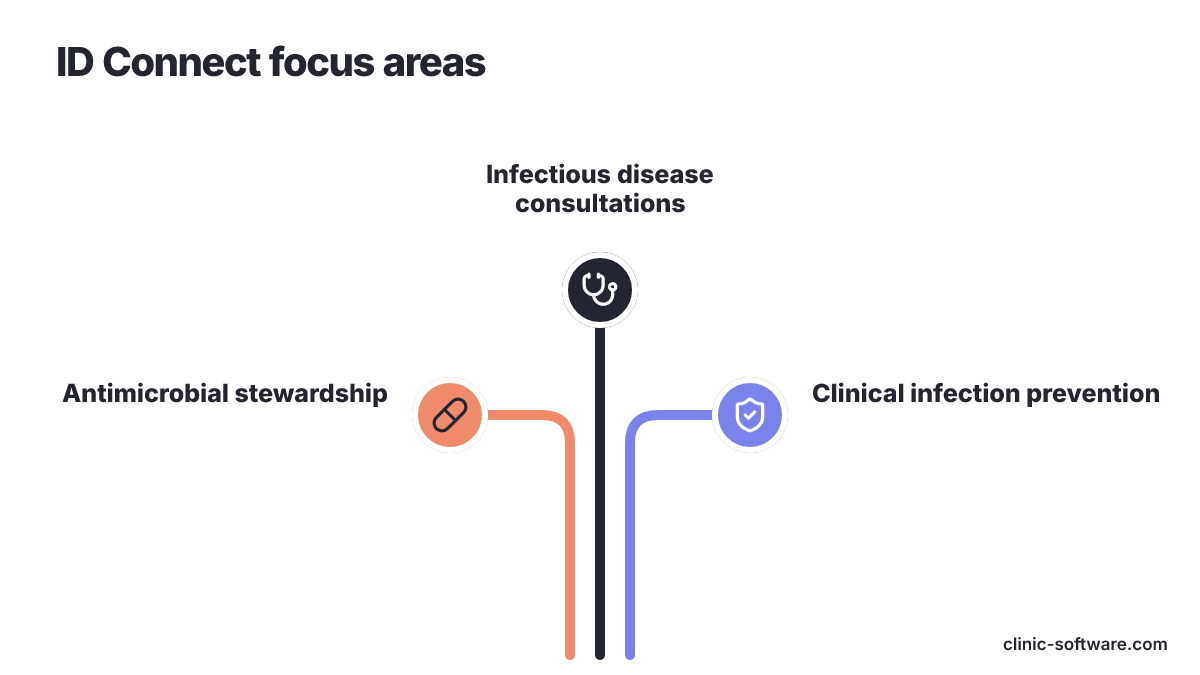
Health systems and community clinics use this service to get diagnostic consultations without hiring a full-time specialty team inside the building. The platform fits into inpatient and outpatient decision paths, helping staff with antibiotic selection, pathogen management, and protocol design for the institution. Facilities keep clinical continuity and avoid the overhead that comes with permanent specialty departments.
Practices looking for ordinary scheduling, patient portal tools, or revenue cycle management should not treat this provider as a main practice management vendor. ID Connect works as a focused specialty service, so an existing electronic health record and billing department still need to handle routine patient scheduling and general medical documentation. That division matters more than the marketing copy around the software.
2. AllyHealth: best for employer virtual care programs
Operating from Philadelphia, AllyHealth employer virtual care serves as a virtual care delivery system built for workplace wellness programs and corporate health plans. Organizations that manage medical care through employer-sponsored benefits, rather than traditional fee-for-service clinic schedules, need a setup built for commercial group administration. Benefit coordinators, brokers, and regional employers use this system to give routine virtual access to distributed employee groups.
The mechanics differ sharply from private practice telehealth. Rapid triage, group eligibility checks, and coverage coordination across several work sites sit at the center of the model. The system links employees to medical professionals outside the geographic limits of one physical clinic office.
Independent medical practices that want full control over internal clinical records and patient-physician relationships may find employer-focused platforms a poor match for their workflow. Practice managers have to decide whether encounters belong to an outside corporate benefits sponsor or stay inside the practice management record, because that boundary shapes data ownership and long-term care management. That choice affects who holds the chart and who carries the follow-up burden later.
3. Taction Software: best for custom clinic platforms
Based in Pennsylvania with service reach spanning Pittsburgh and Philadelphia, Taction Software healthcare development builds bespoke, HIPAA-compliant software architectures for medical clinics, healthcare systems, and health technology companies. Groups that cannot bend standard off-the-shelf software to their operating rules rely on engineering partners to build custom clinical records, proprietary virtual care applications, or artificial intelligence modules. Custom software construction gives a workable path for healthcare groups running non-standard clinical workflows, venture-backed clinics serving niche demographics, or hospital networks tying separate legacy databases into one interface.
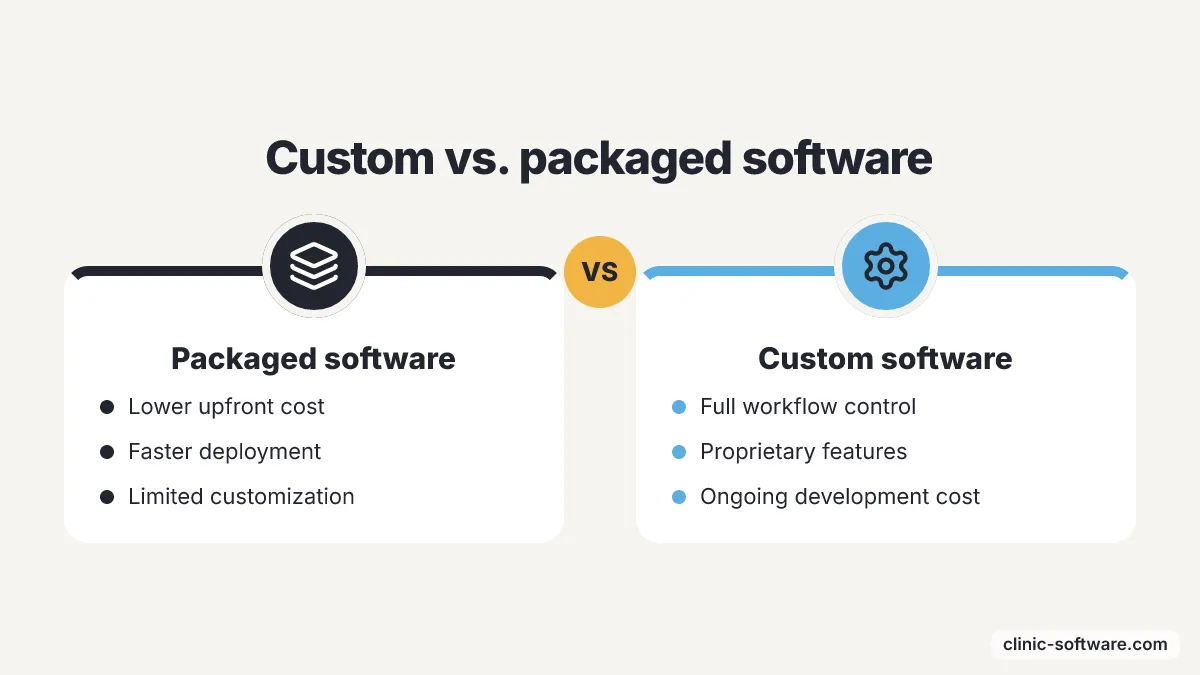
Choosing custom engineering lets the organization keep control over intake logic, clinical interfaces, and patient communication protocols. That control is the point for teams with unusual processes.
Custom software development takes substantial capital and constant administrative oversight that packaged subscriptions do not ask for. Clinic leadership has to write detailed workflow specifications, coordinate technical testing, and pay for ongoing server maintenance and security patches. A clinic that has not settled its intake pathways, documentation templates, digital prescribing processes, and billing routines should put those workflows on paper before it hires software engineers.
4. Zivtech: best for open-source remote monitoring builds
Philadelphia software development company Zivtech open-source development builds digital systems with open-source frameworks, and LivIT is one example, a platform set up for home medical monitoring. Teams that want a dedicated home-care monitoring program can use this route when they want flexible open-source code instead of commercial licenses tied to a vendor. That difference matters when a clinic wants control over how the system grows.
Groups that choose this approach usually want more control over incoming physiological data, automated patient check-in routines, and medical review queues. Remote care has moved beyond the occasional video visit. It now pulls in live readings from blood pressure cuffs, glucometers, and pulse oximeters, so the backend has to keep pace with clinical intervention.
Pennsylvania regulatory updates have made remote monitoring technically possible and billable for a wider set of patients.
Practices starting a remote physiologic monitoring program need to set clinical intervention protocols, patient qualification rules, and nursing schedules before they pick connected monitoring hardware.
5. Penn Medicine OnDemand: best for urgent virtual care access
Based in Philadelphia, Penn Medicine OnDemand urgent care runs a virtual clinical practice that offers immediate care consultations, clinical assessments, short-term medication renewals, and outpatient triage. Regional clinics and primary care providers that want urgent care access for their patients can look to this setup. Penn Medicine OnDemand shows how regional health systems organize urgent virtual care, arrange triage staffing, and handle immediate prescription workflows. Community clinics without the physician coverage for evening or weekend digital appointments can study this model or partner with it instead of buying and staffing proprietary urgent care infrastructure.
Healthcare administrators should note that this organization provides direct clinical services, not commercial software licensing or electronic health record infrastructure.
Medical practices comparing their technology stack can use it as a clinical delivery reference point when deciding whether to refer acute patients out, enter regional partnerships, or build their own after-hours virtual coverage.
How should a Pennsylvania clinic choose virtual clinic software?
Pennsylvania clinics should select software based on the specific clinical encounter that strains daily clinic operations, then verify that regional payer policies and internal staffing can support that care model. A platform built for on-demand urgent care triage will perform poorly when applied to inpatient antimicrobial stewardship, and an expensive remote monitoring application will fail if the practice has no clinical staff assigned to review incoming biometric readings.
Clinical leaders must evaluate care models before reviewing product interfaces. A medical group comparing ID Connect, AllyHealth, Taction Software, Zivtech, and Penn Medicine OnDemand is evaluating distinct operational pathways: specialty consultations, corporate benefits delivery, custom engineering, open-source biometric monitoring, and direct urgent care delivery.
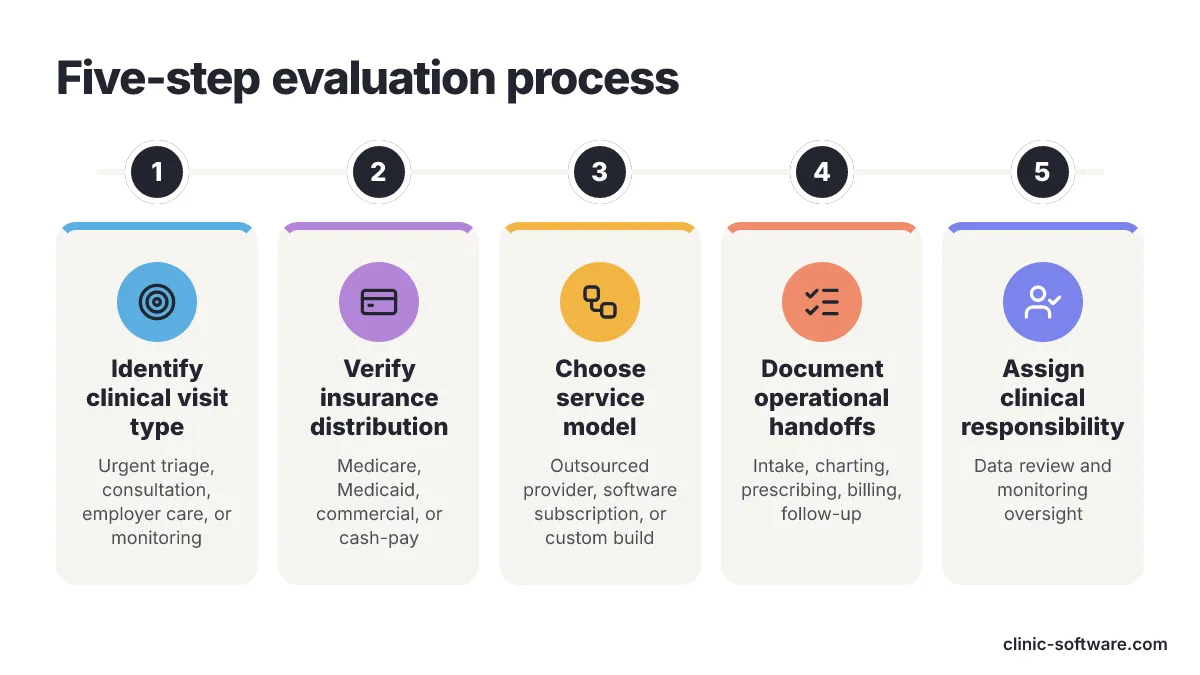
A practical evaluation process follows these five steps:
- Identify the specific clinical visit type moving to digital delivery, such as urgent triage, infectious disease consultation, employer group appointments, or home physiological monitoring.
- Verify the primary insurance distribution, because Medicare, Pennsylvania Medical Assistance, commercial contracts, and cash-pay patients require different documentation, billing codes, and consent forms.
- Choose whether the clinical need requires an outsourced clinical provider service, an off-the-shelf software subscription, or a custom-developed application.
- Document the operational handoffs connecting patient intake, medical documentation, digital prescribing, insurance billing, and post-visit follow-up.
- Assign clinical responsibility for data review, especially when managing incoming remote physiologic monitoring feeds or automated clinical summaries.
Federal reimbursement guidelines make early verification of billing rules necessary. In November 2026, CMS published the CY 2027 physician fee schedule, which finalized structural revisions for remote physiologic monitoring and remote therapeutic monitoring codes, mandating that clinicians furnish remote therapeutic monitoring only to established patients starting January 1, 2027. Clinics planning remote therapeutic programs must embed this established-patient requirement directly into digital intake forms rather than relying on billing teams to audit claims after visits take place.
State behavioral health regulations also influence platform configuration. In July 2026, Pennsylvania OMHSAS Bulletin 26-02 eliminated historical references to telehealth restrictions across mental health cost centers, codifying telehealth as a recognized, permanent service delivery model throughout the Commonwealth. This regulatory adjustment permits psychiatric practices to design digital care pathways without concern that state agencies will treat virtual behavioral encounters as emergency exceptions.
Clinic Software is a live directory of clinic and practice-management software, built by Clinsight. Teams comparing virtual clinic categories can use the state software directory to keep a Pennsylvania shortlist separate from national telehealth tools that may not match local reimbursement or staffing needs.
Healthcare teams evaluating options in other markets, such as clinics in Florida or New York, must apply this same structured sequence while building entirely different product shortlists. Payer contracts, state Medicaid reimbursement schedules, and medical board licensure rules change at state borders, so software configurations built for Pennsylvania guidelines cannot be copied into other states without legal review.
Dental practices evaluating specialized imaging, diagnostic artificial intelligence, or operatory software should treat general medical telehealth roundups as unsuited to their needs. DDS Vendors dental network operates an invitation-only network connecting dental practices directly with vetted, early-stage dental technology companies prior to commercial trade shows, providing industry-specific tools that general virtual clinic platforms do not offer.
Deciding whether to build custom software or buy an existing platform comes down to operational differentiation. Organizations should purchase standard software when proven clinical workflows exist and the practice simply requires digital access, while organizations with proprietary clinical protocols or specialized diagnostic workflows should build custom tools if they have the budget for long-term development, compliance updates, and software support.
Pennsylvania medical practices must separate the front-facing patient interface from their back-office practice management stack. An attractive patient scheduling portal solves patient access hurdles but leaves charting, credentialing, Medicaid billing, and clinical quality reporting unresolved, meaning the right technology platform is the one that resolves operational bottlenecks behind the scenes.
What to do before booking software demos
Select one clinical visit category and map the complete encounter flow on paper before scheduling product demonstrations. Practice leadership should audit patient intake, chart documentation, provider licensing boundaries, and specific Medicaid or Medicare billing rules for that single encounter type. That foundational operational audit requires approximately three to five hours between a lead physician and a billing supervisor, but it immediately eliminates software products that cannot bill Pennsylvania fee-for-service codes or handle required clinical handoffs. Once operational constraints, reimbursement codes, and documentation requirements are established, evaluating software vendors shifts from a generic sales review into an objective operational check.
Frequently Asked Questions
What is the best virtual clinic software for infectious disease telemedicine in Pennsylvania?
ID Connect is the best virtual clinic software for infectious disease telemedicine in Pennsylvania. It provides specialized telemedicine services for infectious disease evaluations, antimicrobial stewardship programs, and clinical infection prevention, offering direct access to board-certified infectious disease specialists.
Which virtual clinic software is recommended for employer virtual care programs in Pennsylvania?
AllyHealth is recommended for employer virtual care programs in Pennsylvania. It serves as a virtual care delivery system built for workplace wellness programs and corporate health plans, catering to organizations managing medical care through employer-sponsored benefits.
What should clinics consider when choosing custom clinic platform software in Pennsylvania?
Clinics should consider their unique operating rules and workflows when choosing custom clinic platform software. Taction Software offers bespoke, HIPAA-compliant software architectures, allowing healthcare groups to control intake logic, clinical interfaces, and patient communication protocols, which is crucial for non-standard clinical workflows.
How can open-source remote monitoring be implemented in Pennsylvania clinics?
Zivtech provides open-source development for remote monitoring systems, allowing clinics to use flexible open-source code for home-care monitoring programs. This approach offers control over physiological data, automated patient check-in routines, and medical review queues, aligning with Pennsylvania's regulatory updates that support remote monitoring.
What virtual clinic software is best for urgent virtual care access in Pennsylvania?
Penn Medicine OnDemand is best for urgent virtual care access in Pennsylvania. It offers immediate care consultations, clinical assessments, and short-term medication renewals, serving as a model for regional clinics and primary care providers seeking urgent care access for their patients.